
Updated: May 2026 | Reading time: 12 min | AMSY Energy
Hydropower accounts for 47% of global renewable electricity and 13.6% of French electricity production in 2024. This essential guide explains how it works, the 5 types of hydroelectric plants, its environmental advantages, costs and the innovations shaping its future in 2026.
Introduction to Hydropower
Hydropower is today the world’s leading source of renewable electricity. It represents 47% of all renewable electricity produced globally, with an installed capacity reaching 1,416 GW in 2023, according to data from the International Energy Agency (IEA).
In France, hydroelectricity accounted for 13.6% of total electricity production in 2024, generating 75.1 TWh — the highest level since 2013, driven by exceptional rainfall (+27% compared to 2023). France ranks as Europe’s 2nd largest hydroelectricity producer, with over 2,600 installations across the country, concentrated in Savoie, Isère and the Alpine corridor.
To better understand the global energy mix, read our article on energy orders of magnitude.
Why Hydropower Is Essential in 2026
Faced with the climate emergency, this energy source plays a unique strategic role: it is simultaneously renewable, dispatchable and capable of storing electricity at large scale. In 2025, France achieved a record net electricity export balance of 92.3 TWh, partly driven by its exceptional hydroelectric output.
How Hydropower Works
The Physical Principle of Hydropower
Hydroelectricity harnesses the potential energy released by water falling from a certain height. The power output P (in kilowatts) is proportional to two fundamental parameters:
- Q: water flow rate in m³/second
- H: head in meters (altitude difference between the intake and the outlet)
The greater the flow rate and the higher the head, the more electricity the plant produces. These two conditions — flow and head — are essential to any hydroelectric production.
How Does a Hydroelectric Plant Work?
The operation of a hydroelectric plant relies on a simple and highly efficient energy conversion chain:
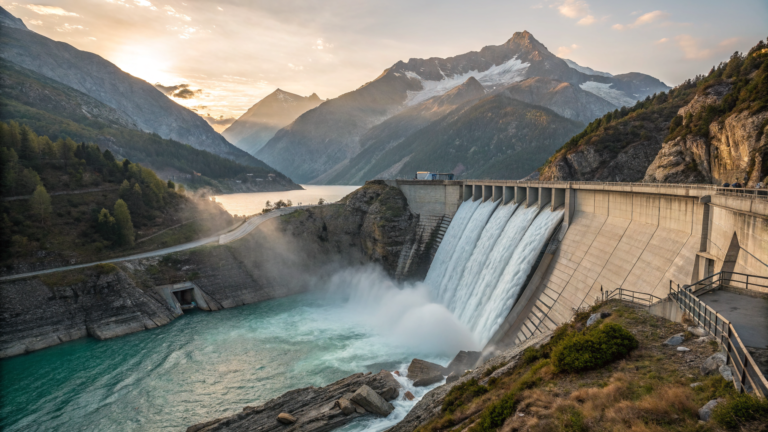
- A dam diverts water from a river toward a turbine
- The hydraulic turbine converts the water’s potential energy into mechanical rotational energy
- The alternator transforms this mechanical energy into alternating electrical current
- A transformer raises the voltage to inject electricity into the grid
This direct conversion chain — with no combustion — allows hydropower to achieve an exceptional efficiency of 95%, the highest of all electricity generation technologies. Unlike coal plants that only reach 35 to 45% efficiency, this technology converts mechanical energy directly into electricity with no combustion step.
Each installation consists of three main equipment families:
- Civil structures: dam, tunnel, powerhouse
- Hydromechanical equipment: gates, turbines, penstocks
- Electrical equipment: alternator, transformer, control and monitoring system
The 5 Types of Hydropower Plants
Not all hydroelectric plants are alike. They are classified according to several criteria: head, installed capacity, and whether or not they can store energy.
1. Run-of-River Plants — Continuous Production
These installations generate electricity in real time, based on the available river flow. They have no storage capacity. In France, over 90% of hydroelectric installations are run-of-river plants. They provide stable and predictable base load production, forming the backbone of the French hydroelectric sector.
2. Reservoir Plants — Dispatchable Production
Reservoir plants store water to generate electricity on demand, particularly during peak consumption periods. In France, two sub-categories exist:
- Pondage plants: storage capacity from 2 to 400 hours
- Lake plants: storage capacity exceeding 400 hours
Although they represent only 10% of French installations, they generate 40% of total hydroelectric power thanks to their high head. They are the most flexible type, capable of starting up within minutes.
3. Pumped Storage Plants (PSP) — Large-Scale Energy Storage
Pumped storage plants account for 99% of global electricity storage capacity according to IRENA (International Renewable Energy Agency). Their principle relies on the bidirectional use of water:
- Off-peak hours: surplus electricity pumps water from a lower reservoir to an upper reservoir
- Peak hours: water is turbined from the upper reservoir to the lower one to generate electricity
The system efficiency exceeds 80%, making it the most efficient of all existing energy storage systems. Learn more in our complete guide on energy storage.
In France, EDF plans to increase its capacity by 4 additional GW, of which 3.5 GW in pumped storage form. The Montézic 2 project (Aveyron), adding 466 MW, is expected to begin construction in 2028 for commissioning in 2035.
4. Small Hydropower — Local and Decentralized Production
Small hydroelectricity covers plants with a capacity below 10 MW. In France, it totals 1.85 GW of installed capacity and produces approximately 7 TWh/year — the equivalent of one nuclear reactor. A small 3.5 MW plant in the French Alps can power the equivalent of 6,500 households per year.
5. Hydrokinetic Turbines — Innovation Without Dams
A more recent innovation in the sector, hydrokinetic turbines require no head. Installed directly in riverbeds, they harness only the water current’s velocity. Ideal for areas without dam infrastructure, they open new perspectives for developing nations.
The 3 Hydroelectric Turbine Technologies
The turbine is the heart of every hydroelectric plant. Each technology corresponds to an optimal head range:
Pelton Turbine — High Head (> 300 m)
Used for very high heads, it operates by water jets impacting buckets. It is mainly found in French Alpine plants.
Francis Turbine — Medium Head (50 to 700 m)
The most widely used technology in the world today, found in both small installations and the world’s largest plant — the Three Gorges Dam in China (22,500 MW).
Kaplan Turbine — Low Head (20 to 60 m)
Suited to low heads, it features adjustable blades that adapt to flow variations. It is commonly found in run-of-river plants on major rivers.
Hydropower Economics: Costs and Profitability
This sector requires high initial investments, but offers some of the lowest operating costs of all energy technologies:
- Initial investment: €1 to 8 million per MW installed
- Fuel (water): free
- LCOE: €20 to 250/MWh depending on the project
- Nuclear cost (for comparison): €60.3/MWh assessed by the CRE for 2026-2028
- Lifespan: over 100 years for some French installations
- Jobs: over 30,000 direct, indirect and induced non-relocatable jobs in France
Unlike thermal plants whose costs are tied to fuel prices, hydroelectricity is completely independent of commodity markets — a major strategic advantage for electricity supply security.
Hydropower: A Pillar of the Electrical Grid
The hydroelectric sector provides 4 essential ancillary services for grid stability, increasingly critical as intermittent renewables grow:
- Frequency regulation: continuous modulation to maintain grid frequency at 50 Hz
- Reactive power: voltage control across the grid
- Black start: grid restart after a total blackout, without external power supply
- Fast start: power generation within minutes
Environmental Performance of Hydropower
Global Advantages of Hydroelectricity
- Conversion efficiency: up to 95%
- Energy return ratio: up to 280 — the highest of all technologies, according to the IPCC
- GHG emissions: among the lowest over the full life cycle, just behind wind power
- Non-consumed resource: water is returned to the natural environment after production
To compare with other low-carbon sources, read our guide on nuclear energy and its 5 reactor technologies.
Local Impacts to Manage
Ecological continuity: A dam is an obstacle to fish migration. The main mitigation measure is the construction of fish passes adapted to local species.
Minimum flow: Most countries require a minimum reserved flow in the bypassed river section at all times, to preserve aquatic life and water quality.
Social impact: These projects must be treated as genuine land development projects and not purely as industrial projects.
2026 Innovations in Hydroelectricity
Variable-speed pump-turbines: Enable ancillary services in pumping mode — a key innovation to support the energy transition.
Fish-friendly turbines: Slow-rotating turbines reduce the ecological impact on migratory fish.
Hydrokinetic turbines: Without dams, they open new territories to the hydropower sector in developing countries.
Capacity extension: In France, EDF has launched preparatory works for Montézic 2 (Aveyron), adding 466 MW of pumping capacity to exceed 1,300 MW total.
Key Figures 2026
- 🌍 47% of global renewable electricity from hydropower
- ⚡ 1,416 GW of installed capacity worldwide (2023)
- 🇫🇷 13.6% of French electricity from hydropower (2024)
- 🏭 2,600+ hydroelectric installations in France
- 💧 25.7 GW of installed capacity in France at end of 2024
- 🔄 Pumped storage represents 99% of global electricity storage
- 📈 Conversion efficiency up to 95%
- 💶 LCOE: €20 to 250/MWh depending on the project
- 👷 30,000+ jobs in the sector in France
- 🕐 Plant lifespan: over 100 years
FAQ — Hydropower
Is hydropower truly renewable?
Yes. This energy source harnesses the natural water cycle, continuously replenished by rainfall and snowmelt. The water driving the turbine is returned to the natural environment and can be reused downstream for other purposes.
What is the difference between a pumped storage plant and a conventional hydroelectric plant?
A conventional plant generates electricity from naturally flowing water. A pumped storage plant is a bidirectional storage system: it consumes electricity to pump water during off-peak hours, and generates electricity by turbining that water during peak hours, with an overall efficiency exceeding 80%.
Can hydropower compensate for the intermittency of solar and wind?
This is precisely one of its major strengths. Pumped storage plants store surplus solar and wind electricity and release it on demand within minutes, ensuring grid stability.
What is the world’s largest hydroelectric plant?
The Three Gorges Dam in China is the world’s largest hydroelectric plant, with an installed capacity of 22,500 MW. China is also the world’s top hydroelectricity producer with 28.9% of global output in 2023.
What is France’s position in global hydroelectricity?
In 2024, France is Europe’s 2nd largest hydroelectricity producer with 11% of European output, and ranks 14th globally with 1.3% of world total.
Why isn’t hydropower developed everywhere?
Its development requires two essential conditions: sufficient water flow and an exploitable head. These conditions are not available everywhere. Furthermore, the social and environmental impacts of large dams require in-depth studies and lengthy consultation processes.
Conclusion on Hydropower
Hydropower is far more than a simple renewable electricity source. With 47% of global renewable electricity and unmatched storage capacity through pumped storage plants, it is the invisible pillar on which our electrical grid stability rests.
In France, with 75.1 TWh produced in 2024 and a 4 GW capacity extension program planned by EDF, this technology is more central than ever to the energy transition. Alongside nuclear energy, hydropower is an indispensable pillar of tomorrow’s low-carbon electricity mix.
To reduce your own daily energy consumption, explore our practical tips on AMSY Energy.
💬 Want to learn more about energy optimization? Contact AMSY Energy: [email protected]
This article was written by the AMSY Energy team, your reference in energy efficiency and ecological transition.
Follow us on LinkedIn for more educational content on hydropower and the energy transition.